On Sex Addiction, CSBD, and Therapy Culture Wars
How Terminology Battles Screw Over Clients in Need
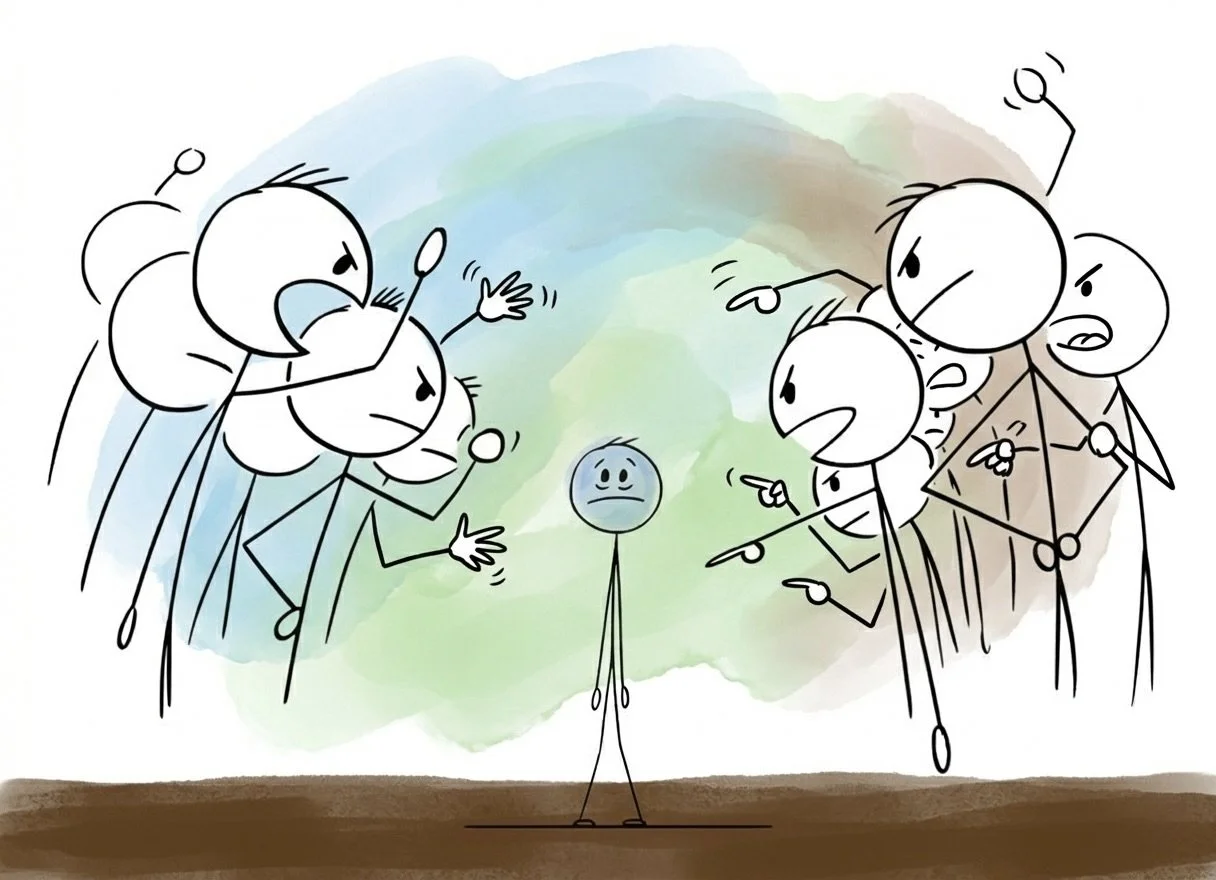
My partner recently attended a gathering with some of her friends, mostly psychotherapists. Many of the guests were in recovery and knew each other from various 12-step groups—Alcoholics Anonymous, CoDA (Codependents Anonymous), MAA (Media Addicts Anonymous), you name it. One thing I’ve always appreciated about people in recovery is their willingness to talk about uncomfortable things with the type of radical honesty you don’t see in most places.
At some point, someone mentioned that I had worked in the field of sex addiction. Without missing a beat, another woman—another therapist—said, “Oh, I don’t believe in that.”
Most of the room pushed back. These were people who often watched compulsive behavior hopscotch from alcohol to gambling to shopping, social media, porn, you name it. “People openly talk about social media addiction all the time,” one person said. “But porn is somehow different?”
When my partner told me about the exchange, I responded with my usual sarcasm-thinly-veiling-frustration: “Oh good. I should probably relay that to the thousands of men who had sought 2 week intensive treatment at my agency…for something that isn’t real.”
To be serious, most of the people I worked with came to treatment in crisis. Most seemed pathologically averse to therapy, so I’m guessing they weren’t spending upwards of $20K for the sheer joy of inner child work. In actuality, some had lost their families. Others had blown their life savings, were fired from their jobs, faced mounting health risks, or all of the above. They knew they were in deep trouble but couldn’t stop their behaviors despite multiple attempts. If only there were a word for this strange phenomenon!
If you think addiction recovery is hard—working with shame, retraining your nervous system, dismantling decades-old habits, rebuilding your relationship with the world—imagine doing that while licensed therapists tell you the thing you’re seeking help for doesn’t actually exist.
When Therapists Get It Wrong
I’ve heard versions of this in my own office. Partners come to me in crisis after learning their spouse has been lying for years. Meanwhile, their husband’s therapist has earnestly suggested that maybe the real issue is the partner’s prudishness or that they should consider opening up the marriage. For people exploring polyamory in good faith, the therapy office can be a wonderful place to unpack those questions with rawness and honesty. For someone who’s been betrayed, gaslit, and emotionally abused through years of secret sexual compulsivity, those suggestions can feel like therapeutic malpractice.
Unfortunately, this isn’t as rare as you’d think, especially for well-meaning but untrained therapists who don’t know the warning signs. Serial adulterers or compulsive porn users who haven’t come to terms with their problem often convince their therapist that their “controlling” partner is the real problem—while conveniently omitting the part where they’ve been living a double life. Some in the sex-positive community (which I count myself part of) are surprisingly susceptible to these manipulations. In the quest to be affirming to their client, they may forget to challenge them around the foundational requirement of open relationships: the “open” part. Openness requires honesty. Without it, everything else is just a performance.
The Terminology Wars
To be fair, the term “sex addiction” has been controversial since its inception. Like every field, it’s had growing pains. It’s not a great term, to say the least. I actually hate it, opting for “intimacy disorder” instead to cover a whole host of problems, from addiction to intimacy avoidance. And it’s certainly been misused—especially in fundamentalist religious circles—to over-diagnose sexual behaviors and kinks that may (or may not) fall outside of mainstream norms. Powerful people committing a whole host of sexual crimes have attempted to use the term to play victim and shield abuse. And it’s not a formal clinical label.
But neither is “alcoholic,” and no one storms an AA meeting insisting it be renamed “Alcohol Use Disorder Anonymous.” People use the term because it communicates a shared experience. It’s how people talk outside of therapy circles.
And believe it or not, the field has significantly evolved. Trainings now begin with warnings about over-pathologizing and stigmatization, going out of their way to discuss what sex addiction is not. Therapists learn to focus on distress and negative consequences rather than value judgments around behaviors or patterns of frequency.
Most experienced professionals who choose not to use the term still acknowledge that the problem exists. The American Association of Sexuality Educators, Counselors, and Therapists (AASECT), which has disavowed the “addiction” term, “recognizes that people may experience significant physical, psychological, spiritual and sexual health consequences related to their sexual urges, thoughts or behaviors.”
But for others, the exercise has become a magic act, an act of willful denial. What is essentially a semantic argument goes poof! Not only is the term problematic. The problem just doesn’t exist…at all. It’s all about shame, see. Or a symptom of societal repression. The problem is, shame and societal repression play a role in most people’s addictive behaviors. Why would sex be any different?
Most ironic, the backlash to the term can sometimes appear even more overzealous. Go the informal route and check Wikipedia for “sex addiction,” and you'll be greeted with an entry dripping with contempt from the first sentence. Instead of offering a balanced overview with a “controversy” section like most entries, the entire page reads like a polemic. My personal favorite line: “A paper dating back to 1988 and a journal comment letter published in 2006 asserted that sex addiction is itself a myth.”
A paper… from 1988… said that? And a comment letter? Thank you, Wikipedia. Case closed, I guess.
Clinical Purgatory…With Real Consequences
Meanwhile, critics rarely offer a workable alternative. Professional organizations tiptoe around the subject, offering vague “let’s wait for the evidence to come in” statements. Those who take the problem seriously have tried to find more palatable terminology—“hypersexuality,” “out-of-control sexual behavior,” “problematic sexual behavior”—in an attempt to avoid the perceived sex-negativity of the addiction label.
Much like “substance use disorder” replaced “alcoholism,” these terms aim for precision and neutrality. Great. But in chasing the gold-standard phrasing, the field has ended up in a kind of clinical purgatory: endless debate, little consensus, and barriers to care for anyone who isn’t wealthy enough to pay out-of-pocket.
Because in the real world, ignoring this problem—whatever you want to call it—has consequences. The lack of consensus has led to denial of insurance coverage and made effective treatment inaccessible for tens of thousands of people. Proposed diagnoses for sexual compulsivity, like ‘Hypersexual Disorder,’ have repeatedly stalled in DSM revisions—not due to a lack of evidence, but because there were concerns about stigma or using the term in legal settings. Arguments that seem thin when you realize alcohol and drug addictions have been in the DSM for decades and used in legal contexts without anyone declaring a crisis.
The result? Patients are left navigating a system that treats a serious, treatable condition like an optional sideshow. There are now over seven nationally-recognized 12-step groups related to love and sexual compulsivity, including Sex Addicts Anonymous, Sex and Love Addicts Anonymous, Sexual Compulsives Anonymous, Sexual Recovery Anonymous, and Sexaholics Anonymous. A remarkably high number of groups for something that doesn’t exist!
But none of these are clinical interventions. And when treatable conditions go unaddressed, shame grows, secrecy deepens, behaviors escalate, and the consequences can become far worse for individuals and their families. And if things escalate into legal territory, guess who ends up handling the fallout? The courts—and the taxpayers who fund them.
Enter the World Health Organization
Thankfully, some parts of the world have chosen action over paralysis. The World Health Organization’s ICD-11 includes Compulsive Sexual Behavioral Disorder (CSBD) as a real condition, describing it as:
“Repetitive sexual activities becoming a central focus of the person’s life to the point of neglecting health and personal care or other interests, activities and responsibilities; numerous unsuccessful efforts to significantly reduce repetitive sexual behaviour; and continued repetitive sexual behaviour despite adverse consequences or deriving little or no satisfaction from it… The pattern… is manifested over an extended period of time… and causes marked distress or significant impairment… Distress that is entirely related to moral judgments and disapproval… is not sufficient to meet this requirement.”
Unlike the American Psychological Association, the creators of the ICD-11 chose decisiveness over political hand-wringing, classifying CSBD under impulse disorders. Others conceptualize it closer to obsessive-compulsive behavior. In reality, it probably shares characteristics with both. But consensus has proven that, however you define the problem, the solution comes through the types of openness, honesty, and camaraderie that recovery communities are uniquely positioned to address.
What the Future Holds..
At another recent gathering, I ended up seated near the woman who had declared to a group of addicts that sex addiction wasn’t real. I wondered if she was the therapist who had advised one of my female clients that her supposed prudishness or reluctance to open the marriage might explain her husband’s secrecy—a conclusion the therapist reached without noticing the tell-tale signs that he’d been acting out for years.
Fortunately, her supervisor was there too. We started talking about sex therapy, pleasure, open relationships, and yes—sex addiction (admittedly, not necessarily the type of things you typically hear at a party, but don’t call us prudes.) “I know your agency,” she said, referring to a past job. “One of my clients went there. He said the experience was transformative.”
Sex addiction, hypersexuality, compulsive sexual behavior disorder, call it whatever you want. The people suffering care way less about terminology than restoring their lives, careers, and families. In the meantime, it’s long overdue that the architects of the DSM-6 catch up with the rest of the world. Otherwise, these endless, tedious debates amount to little more than intellectual masturbation.
Ryan Lappi is an LCSW practicing in Colorado. He’s also the creator of Beyond Normality, which can be found at beyondnormality.substack.com.